Can hexane be burned
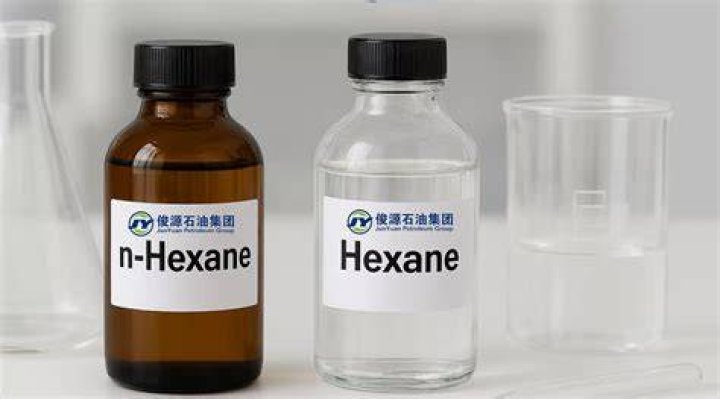
Assuming that there is an adequate amount of available oxygen, hexane burns “cleanly” that is the only by-products of a hexane fire are water and carbon dioxide.
What happens when hexane is burned in air?
The combustion of hexane (C6H14) is represented in the balanced equation : 2 C6H14 + 19 O — 12 CO2 + 14 H2O MM hexane 86.18 g/mole, O2 32 g/mole, CO2 44 g/ mole, H2O 18 g/mole A. If 45 g of hexane is reacted and 45 g of water is recovered.
When hexane is ignited the color of the flame is?
The flame is large, reddish orange, and very smoky.
What is the combustion reaction for hexane?
The balanced chemical equation for the combustion of hexane is: 2C6H14(g)+19O2(g)→12CO2(g)+14H2O(g) 2 C 6 H 14 ( g ) + 19 O 2 ( g ) → 12 C O 2 ( g ) + 14 H 2 O ( g ) .
How hot does hexane burn?
Hexane has a flash point of -7°F, an ignition temperature of 437°F to 835°F, and an explosive (flammable) range of from 1.1 to 7.7 percent. This narrow explosive range is one of the properties that makes it an ideal gasoline additive.
Why does hexane burn with a sooty flame?
The gas burns with a highly-sooty flame, producing thick, black smoke. This happens because of incomplete combustion of the saturated hydrocarbon in the air. … The flame is sooty because the percentage of carbon is comparatively higher than that of alkanes and so does not get completely oxidized in air.
Is hexane a gas at room temperature?
Hexanes are significant constituents of gasoline. They are all colorless liquids at room temperature, odorless when pure, with boiling points between 50 °C and 70 °C. They are widely used as cheap, relative safe, largely unreactive and easily evaporated non-polar solvents.
What happens if n hexane is heated with high temperature and in the absence of air?
Experiments and simulations both show that in the same reactor either a slow reaction or an ignition event can take place depending on the heating rate. … A mixture that approaches the ignition region sufficiently rapidly undergoes only a moderate amount of thermal decomposition and explodes quite violently.
Is hexane more flammable than gasoline?
Fuel Gas”Lower Explosive or Flammable Limit” (LEL/LFL) (% by volume of air)”Upper Explosive or Flammable Limit” (UEL/UFL) (% by volume of air)Hexane1.17.5
Why is hexane a liquid at room temperature?
In HEXANE, because London forces increase with molecular mass, at room temperature dispersion forces > kinetic energy, so hexane is a liquid. However, as temperature is raised, kinetic energy increases and at a certain point hexane will become a gas.
Article first time published on
Is hexane a neurotoxin?
While hexane is approved for use in food by the Food and Drug administration (FDA), according to the Center for Disease Control (CDC), high levels of hexane are considered neurotoxic and are classified as an air pollutant by the EPA.
Why does hexane have a high boiling point?
Hexane has a larger surface area, and therefore the greater dispersion forces and higher boiling point.
What does hexane react with?
n-Hexane can react vigorously with oxidizing materials such as liquid chlorine, concentrated oxygen, and sodium hypochlorite. n-Hexane will attack some forms of plastics, rubber, and coatings.
What happens to the boiling point of hexane as it become more branched?
Therefore, the boiling points of the alkanes increase with molecular size. Where you have isomers, the more branched the chain, the lower the boiling point tends to be. Van der Waals dispersion forces are smaller for shorter molecules and only operate over very short distances between one molecule and its neighbors.
Which is more flammable hexane or potassium sulfate?
Between the two compounds, hexane and potassium sulphate, hexane is the more flammable compound. … On the other hand, the flammability of potassium sulphate is very low because it is an ionic compound whose volatility is very low.
Which isomer of hexane has the highest boiling point?
# of CarbonsAcyclic Alkane# of Isomers2ethane13propane14butane25pentane3
What is the boiling point of hexane in Centigrade?
Physical PropertiesBoiling point68.7°CVapor pressure124 Torr at 20°CFreezing point-95.3°CRefractive index1.3749 at 20°C
What happens when you burn Ethanethiol?
Ethanethiol (C2H6S) is a compound with a disagreeable odor that is used to impart an odor to natural gas. When ethanethiol is burned, the sulfur reacts with oxygen to form SO2.
How much energy does hexane release?
3.88×10⁵J 3.88 × 10 5 J of energy will be released when 16.08 grams of hexane undergoes combustion.
Why alkane does not react with bromine?
Bromine water is an orange solution of bromine. It becomes colourless when it is shaken with an alkene. Alkenes can decolourise bromine water, but alkanes cannot. … This has the effect of ‘saturating’ the molecule, and will turn an alkene into an alkane.
What is the chemical equation for burning ethanol?
The thermochemical equation for the combustion of ethanol is as follows: C2H5OH(l) + 3 O2(g)…
When hexane h6h14 is reacted in the presence of oxygen gas the products of this combustion reaction are?
When hexane (C6H14) ( C 6 H 14 ) is burned in oxygen, the products are carbon dioxide and water. What is a balanced equation for this reaction? Identify the mole ratios between hexane, oxygen, and carbon dioxide.
What products will form from the combustion of hexane and oxygen?
The combustion reaction of hexane (C6H14) and oxygen gas to produce carbon dioxide.
How do you calculate heat of combustion?
Find the amount of substance burned by subtracting the final mass from the initial mass of the substance in g. Divide q in kJ by the mass of the substance burned. The answer is the experimental heat of combustion in kJ/g.
Does bromine react with hexane?
Reaction between bromine and hexane Hexane is a colorless liquid Bromine is a corrosive and poisonous brown liquid Exposed to light, the mixture of these two liquids loses its color. Bromine reacted with hexane to form a colorless product. Blue litmus paper reddened under the influence of hydrogen bromide.
Why does hexane produce soot?
Both hexane and hexene burnt in the air with yellowish flame with hexene producing more soot compare to hexane. This is because the percentage of carbon by mass of hexane is higher than the percentage of carbon by mass of hexene. The combustion flame of alkenes produces more soot than the alkane.
Why the flame of acetylene is smoky luminous flame?
The oxy-acetylene flame consists of oxygen. Acetylene is composed of carbon and hydrogen (C2H2), and the gas burns in air with a smoky flame. When oxygen is mixed with the acetylene in equal proportions a blue, non-luminous flame is produced, the most brilliant part being the blue cone at the centre.
Do alkanes burn with a smoky flame?
Alkanes generally burns with a clear flame. They burn in air with a blue and non-sooty flame as the carbon percentage in the alkane is low and it gets oxidized completely in air and that’s why it burns with a clear flame.
Why is hexane toxic?
Enzymes in your liver break down n-hexane. If you are exposed to high concentrations of n-hexane over a long period, one of these breakdown products may cause damage to your nervous system. Most of these breakdown products leave your body in the urine within a day or two.
What are the main hazards of hexane?
- Acute Effects:
- Acute inhalation exposure of humans to high levels of hexane causes mild CNS depression. …
- include dizziness, giddiness, slight nausea, and headache in humans. ( …
- Acute exposure to hexane vapors may cause dermatitis and irritation of the eyes and throat in humans. (
Is hexane a hazardous waste?
► Keep n-Hexane out of confined spaces, such as sewers, because of the possibility of an explosion. a HAZARDOUS WASTE.