Is the talus concave
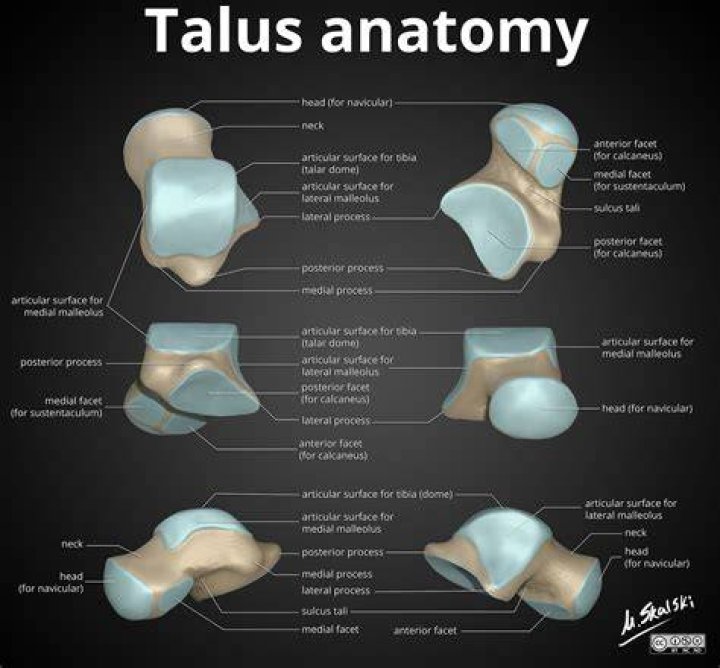
The posterior talocalcaneal articulation is formed by a concave surface of the talus and a convex surface of the calcaneus.
Is the ankle convex or concave?
It is concave in non-weight bearing and runs medial to lateral in the midtarsal and tarsometatarsal area. The bony component of the arch consists of the metatarsal heads, cuboids and 3 cuneiform bones. The medial and lateral pillars of the arch is formed by the medial and lateral longitudinal arch respectively.
Is subtalar joint convex on concave?
Both the anterior and middle facets are concave, while the posterior facet is convex.
What type of bone is talus?
The talus is the bone at the top of the foot that serves as a perch for the tibia and holds the weight of the entire body. The talus is considered a short bone and is one of the main bones of the ankle.
Is the tibia concave or convex?
The femur is a convex surface and the tibia is a concave surface. During a squat, the femur moves on a stable tibia. The femur rolls posteriorly and slides anteriorly on the tibia. The roll and glide/slide occur in opposite directions, according to the “convex on concave” rule.
Which joint is concave convex?
Examples: Glenohumeral articulation: concave glenoid fossa articulates with the convex humeral head.
What is talus quizlet?
Mechanical weathering is the process of breaking big rocks into little ones. … Geologists define talus as the pile of rocks that accumulates at the base of a cliff, chute, or slope.
Is the tarsal bone axial or appendicular?
The pelvis, femur, fibula, tibia and all of the foot bones as well as the scapula, clavicle, humerus, radius, ulna and all of the hand bones are classified as appendicular.
What is inversion of foot?
“Inversion of the foot happens when the foot rolls laterally so that the sole of the foot is facing medially,” explains Stephen B. … “In athletes, it is the most common type of hypermobility injury in the foot and the reason for the majority of ankle and foot sprains.”
What is talus in anatomy?
The talus (plural: tali 4), also known as the astragalus 4, is a tarsal bone in the hindfoot that articulates with the tibia, fibula, calcaneus, and navicular bones. It has no muscular attachments and around 60% of its surface is covered by articular cartilage.
Article first time published on
What type of bone is the tibia?
The tibia is categorized as a long bone and is as such composed of a diaphysis and two epiphyses. The diaphysis is the midsection of the tibia, also known as the shaft or body.
What type of joint is the ankle?
Overview. The ankle joint is a hinged synovial joint with primarily up-and-down movement (plantarflexion and dorsiflexion). However, when the range of motion of the ankle and subtalar joints (talocalcaneal and talocalcaneonavicular) is taken together, the complex functions as a universal joint (see the image below).
What is tarsal joint?
The transverse tarsal joint separates the rearfoot from the midfoot (see Fig. 11.1). This extensive joint consists of two separate articulations: the talonavicular joint and the calcaneocuboid joint. This pair of joints allows the midfoot to move independently of the rearfoot (i.e., the calcaneus and talus).
Is the ankle a plane joint?
The ankle joint is a hinge type joint, with movement permitted in one plane. Thus, plantarflexion and dorsiflexion are the main movements that occur at the ankle joint. Eversion and inversion are produced at the other joints of the foot, such as the subtalar joint.
Is the distal femur concave or convex?
The femur is CONVEX, so its surface will slide in the OPPOSITE direction to the femur movement (picture 3).
What are concave and convex?
Concave means “hollowed out or rounded inward” and is easily remembered because these surfaces “cave” in. The opposite is convex meaning “curved or rounded outward.” Both words have been around for centuries but are often mixed up. Advice in mirror may be closer than it appears.
What are gliding movement?
Gliding Movement Gliding movements occur as relatively flat bone surfaces move past each other. Gliding movements produce very little rotation or angular movement of the bones. The joints of the carpal and tarsal bones are examples of joints that produce gliding movements.
What are talus cones?
A talus cone is formed by the dry accumulation of loose scree material. The debris cones come out of a high-angle bedrock ravines and accumulate against the valley bottom. … Talus cones developing by rockfall exhibit sorting into fine particles at the top and coarse particles at the bottom.
Which bones articulates with the talus at the ankle joint quizlet?
- Tibia. Larger of Two Lower Leg Bones; medial bone.
- Fibula. A long thin bone positioned laterally alongside the tibia in the lower leg.
- Talus. Articulates with the tibia and fibula, forming the ankle joint. …
- calcaneus. …
- cuboid. …
- Cuneiform. …
- Metatarsals. …
- Phalanges.
What is the erosion or disintegration of rocks building materials etc caused by chemical reactions?
Weathering describes the breaking down or dissolving of rocks and minerals on the surface of the Earth. Water, ice, acids, salts, plants, animals, and changes in temperature are all agents of weathering. Once a rock has been broken down, a process called erosion transports the bits of rock and mineral away.
Is the elbow joint concave or convex?
Toggle Anatomy System On the lateral side, the concave end of the head of the radius meets the rounded, convex capitulum to complete the elbow joint. The loose union of the capitulum of the humerus and the head of the radius allows the radius to pivot as well as flex and extend.
What are shoulder joints?
The shoulder is one of the largest and most complex joints in the body. The shoulder joint is formed where the humerus (upper arm bone) fits into the scapula (shoulder blade), like a ball and socket. … The clavicle (collarbone) meets the acromion in the acromioclavicular joint.
Is the distal humerus concave or convex?
The humeroradial joint consists of the articulation between the convex capitulum of the distal humerus and the slightly concave proximal surface of the radial head.
What is inversion of ankle?
The most common low ankle injury is called an inversion ankle sprain. This occurs when the ankle rolls inwards, stretching the connecting tissue within the ankle joint. Eighty percent of all low ankle injuries are inversion sprains, with the remainder being eversion sprains.
What is ankle inversion and eversion?
Movement at the ankle is controlled by two joints. … Eversion (tilting of the sole of the foot away from the midline) and inversion (tilting of the sole of the foot inwards towards the midline) is controlled by the subtalar joint formed between the talus and calcaneus bones of the foot.
Is the fibula convex or concave?
The articular surfaces of this joint are the triangular convex surface on the medial aspect of the distal end of the fibula and the reciprocally concave fibular notch on the distal end of tibia.
Which surface is concave?
A concave is a surface or a line that is curved inward. In geometry, it is a polygon with at least one interior angle greater than 180°.
Is the hip joint concave on convex?
The arthrokinematics of the hip joint abide by the principles of the convex on concave and concave on convex rules [23]. These principles state that when a convex surface (i.e., femoral head) moves on a concave surface (i.e., acetabulum), the motion between the joint surfaces occurs in the opposite directions.
Is the shoulder part of the axial skeleton?
These are (1) the axial, comprising the vertebral column—the spine—and much of the skull, and (2) the appendicular, to which the pelvic (hip) and pectoral (shoulder) girdles and the bones and cartilages of the limbs belong.
Is the neck part of the axial skeleton?
The axial skeleton forms the vertical axis of the body and includes the bones of the head, neck, back, and chest of the body. It consists of 80 bones that include the skull, vertebral column, and thoracic cage.
What is part of the appendicular skeleton?
The appendicular skeleton is comprised of the upper and lower extremities, which include the shoulder girdle and pelvis. The shoulder girdle and pelvis provide connection points between the appendicular skeleton and the axial skeleton to where mechanical loads transfer.