Is tuba a treble clef
Traditional British-style brass band parts for the tuba are usually written in treble clef, with the B♭ tuba sounding two octaves and one step below and the E♭ tuba sounding one octave and a major sixth below the written pitch.
Can a tuba play treble clef?
Re: Tuba questions In some parts of the world, and in some ensembles, tubas do read treble clef music. British-style brass bands, for example, traditionally have ALL of the parts except the third/bass trombone written in either Eb or Bb treble clef.
What instrument family is the tuba in?
What are the members of the tuba family? Tubas are brass instruments with the lowest tonal range, but they have slight variations. In addition to different possible structures, the four main pitches are F, E♭, C, and B♭. The baritone, euphonium, and sousaphone are also companions of the tuba.
What clef is a tuba in?
Eb and Bb tubas are written in treble clef. The Eb tubas sound 1 octave+a 6th below the written note while the Bb tubas sound 2 octaves lower than written.
Is trumpet a treble clef?
The trumpet is one of many instruments that plays in treble clef. Treble clef is also known as “G clef” for two reasons.
What clef does trombone play in?
Trombone music, along with music for euphonium and tuba, is typically written in concert pitch in either bass or tenor clef, although exceptions do occur, notably in almost all brass-band music where tenor trombone is presented as a B♭ transposing instrument, written in treble clef.
Is tuba C an instrument?
For the euphonium and tuba, however, music is written in the key of C, despite the instruments being in the key of B♭. This is based on orchestral conventions. … That is why we currently may see sheet music written in the treble clef (for easy fingering) but intended for a B♭ instrument.
What are the notes on a tuba?
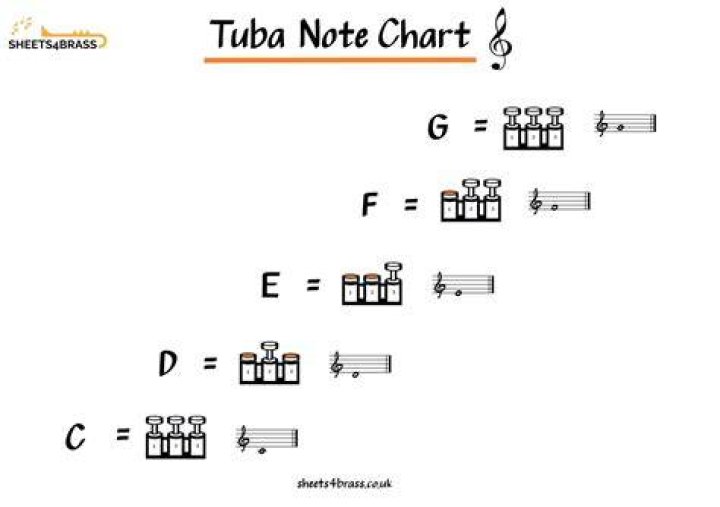
The first of these notes are usually, in concert pitch and on the tuba, B-flat, C, D, E-flat, and F. After mastering the notes of the B-flat Major scale, you are ready to move on to these 5 new ones!
Is tuba an F instrument?
The E♭ tuba often plays an octave above the contrabass tubas in brass bands, and the F tuba is commonly used by professional players as a solo instrument and, in America, to play higher parts in the classical repertoire. … In the United Kingdom, the E♭ is the standard orchestral tuba.
Is tuba a BB instrument?
BBb tuba is a non-transposing instrument. The low Bb that comes out would be written as the Bb below the 2nd ledger line underneath the bass clef staff. … But for most American-published music–anything you’d play with a concert band or orchestra–the tuba would play/read in concert pitch.)
Article first time published on
What does the word tuba literally mean?
From Latin tuba (“tube, trumpet, military trumpet”), first borrowed as a historic term in the 18th century.
Is a tuba a horn?
The word tuba means trumpet or horn in Latin. But tubas are a LOT bigger than trumpets. A trumpet weighs about 1.3 kilograms, but a tuba weighs a whopping 13.6 kilograms! It’s so heavy that tubists hold them across their laps while playing them (instead of lifting them up to their mouths, like a trumpet or a trombone).
What clef is cello?
Most cello music will be written in the bass clef and occasionally moves into tenor clef as the music gets higher. When the music is very high the treble clef is used.
What clef is flute?
Instruments that use the treble clef include violin, flute, oboe, cor anglais, all clarinets, all saxophones, horn, trumpet, cornet, vibraphone, xylophone, mandolin, recorder, bagpipe and guitar.
What clef is French horn?
Most commonly, the horn is played in the range between pedal C (in the bass clef) and the top C (above the stave of the treble clef).
Do tubas have rotary valves?
Tubas come in a choice of rotary valves or piston valves. Similar to the valves on a trumpet, piston valves move up and down to forward air into various combinations of tubing, for the purpose of changing notes. These extend the length of the instrument. Rotary valves direct air into various tubing paths by rotating.
What is tuba in Tagalog?
Definition for the Tagalog word tuba: tubâ [noun] palm wine; coconut wine; alcoholic drink made from palm sap, a type of alcohol. Root: tuba. Frequent.
What clef is oboe in?
Oboe music is written in the treble clef and is in the key of C. The oboe is a non transposing instrument. Its range is from Bb below middle C to a´´´´ (an A four ledger lines above the staff). English horn: A member of the oboe family, this double reed instrument is pitched lower than the oboe.
What clef is euphonium in?
The euphonium may be played in bass clef as a non-transposing instrument or in treble clef as a transposing instrument. In British brass bands, it is typically treated as a treble-clef instrument, while in American band music, parts may be written in either treble clef or bass clef, or both.
What clef is bassoon?
The bassoon player produce the sound by blowing into the reed. It is pitched in the key of C, notated in bass clef, although the tenor clef is used for highest registers.
What type of instrument is a flute?
A flute can be described as a woodwind instrument, generally of a tubular shape, that is played by blowing across a specially-shaped opening (known as the embouchure) in such a way as to produce a vibrating column of air whose pulsations we hear as sound.
Is a tuba hard to play?
Although the tuba is not the hardest brass instrument, the long and wide pipe work requires more lungs and lip power than smaller instruments. The most challenging aspect of tuba is playing the high ranges, although the lower register also has its difficulty as the note are harder to distinguish.
What Clef is Viola?
Introduction to the Viola As the middle voice in a string section, the viola similar to the alto voice in a choir. In fact, the viola uses its very own clef, called the alto clef.
How many notes are on a tuba?
By buzzing the lips faster or slower, the player can cause the air in the tube to resonate at different harmonics. In order to get all 12 notes of the chromatic scale, the player needs to change the length of the tube by moving a slide or by pressing valves.
How old is the tuba?
The first tuba was made on September 12, 1835 After their invention, valves were incorporated into a variety of brass instruments and spurred the creation of one new musical device after another. The basstuba, historical precursor to the modern tuba, made its appearance on September 12, 1835.
Who plays the tuba?
A person who plays the tuba is called a tubaist, a tubist, or simply a tuba player. In a British brass band or military band, they are known as bass players.
Is tuba a real word?
noun, plural tu·bas for 1a, b; tu·bae [too-bee, tyoo-] for 1c. Music. a valved, brass wind instrument having a low range.
Is tuba capitalized?
The names for musical instruments are not capitalized. A noun is a person, place or thing which we don’t capitalize but proper nouns refer to a specific person, place or thing which we do capitalize.
How old is the trumpet?
The first known metal trumpets can be traced back to around 1500BC. Silver and bronze trumpets were discovered in the grave of King Tut in Egypt, and other ancient versions of the instrument were found in China, South America, Scandinavia, and Asia.
Is saxophone a brass?
Though the saxophone is made of metal, it generates sound with a single reed, and so it is classified as a woodwind rather than as a brass instrument.
What is the sound of a tuba?
Tuba players create the low-pitched sound by making a kind of “buzz” with their breath against the mouthpiece and pressing the tuba’s valves to form notes.