Is Uranus a gas giant
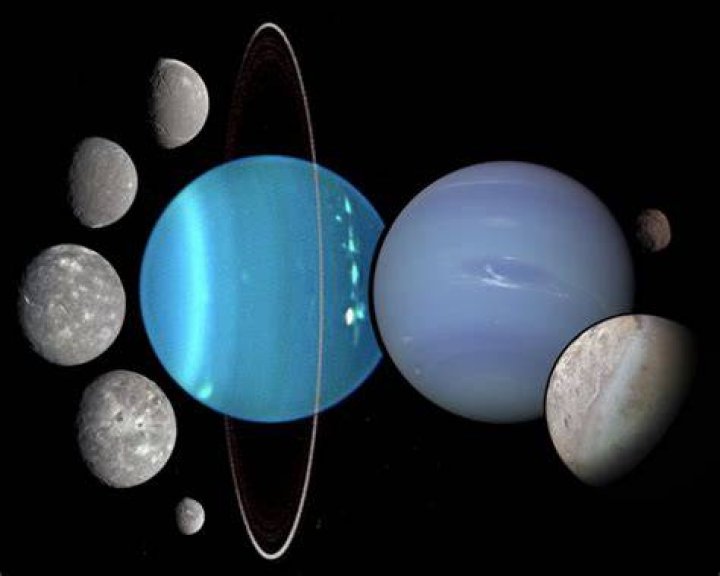
A gas giant is a large planet composed mostly of gases, such as hydrogen and helium, with a relatively small rocky core. The gas giants of our solar system are Jupiter, Saturn, Uranus and Neptune.
Is Uranus a gas giant or ice giant?
The cold and remote giant planets Uranus and Neptune are nicknamed the “ice giants” because their interiors are compositionally different from Jupiter and Saturn, which are richer in hydrogen and helium, and are known as the “gas giants.” The ice giants are also much smaller than their gaseous cousins, being …
Is Uranus a land or gas?
Uranus is a ball of ice and gas, so you can’t really say that it has a surface. If you tried to land a spacecraft on Uranus, it would just sink down through the upper atmosphere of hydrogen and helium, and into the liquid icy center.
Why is Uranus not a gas giant?
Uranus (left) and Neptune are classified as ice giant planets because their rocky, icy cores are proportionally larger than the amount of gas they contain. … Beneath their relatively thin outer shells of hydrogen and helium, these planets’ mantles are largely made of compressed, slushy water and ammonia.
Is Uranus rocky or a gas?
Uranus is an ice giant (instead of a gas giant). It is mostly made of flowing icy materials above a solid core. Uranus has a thick atmosphere made of methane, hydrogen, and helium.
Is Venus a gas planet?
Planetary data for VenusVenusian year (sidereal period of revolution)224.7 Earth daysmaximum visual magnitude−4.6
Are Uranus and Neptune gas giants?
The four gas giants in our solar system are Neptune, Uranus, Saturn, and Jupiter. These are also called the Jovian planets.
What 2 planets have 53 moons?
Planet / Dwarf PlanetConfirmed MoonsTotalMars22Jupiter5379Saturn5382Uranus2727
How is Saturn a gas giant?
Saturn’s surface Saturn is classified as a gas giant because it is almost completely made of gas. Its atmosphere bleeds into its “surface” with little distinction. If a spacecraft attempted to touch down on Saturn, it would never find solid ground.
Why is Uranus called Ice Giant?
Given their large distances from the Sun, Uranus and Neptune are much colder and have a higher abundance of atmospheric water and other ice-forming molecules, earning them the nickname “ice giants.” Ice giants are mostly water, probably in the form of a supercritical fluid; the visible clouds likely consist of ice …
Article first time published on
What gases make up Uranus?
Like the other gas giants, Uranus has an atmosphere composed of mostly hydrogen, followed by helium and a little methane. What is very interesting about Uranus is that the planet has an enormous 98 degree tilt on its axis.
Does Uranus rain diamonds NASA?
Deep within Neptune and Uranus, it rains diamonds—or so astronomers and physicists have suspected for nearly 40 years. The outer planets of our Solar System are hard to study, however. Only a single space mission, Voyager 2, has flown by to reveal some of their secrets, so diamond rain has remained only a hypothesis.
Can u walk on Uranus?
You can’t stand on Uranus That’s because Jupiter, Saturn, Uranus and Neptune don’t have solid surfaces – they have a rocky core, but are mainly big balls of hydrogen and helium.
Is Pluto a gas giant?
So inconspicuous that it was not discovered until 1930, Pluto is not a gas giant planet like all the others in the outer solar system. Instead it is a small, rocky world about the size of Earth’s Moon. … Pluto now seems to be about 3000 to 3500 kilometers (1900 to 2200 miles) in diameter.
Which planet is not a gas giant?
In this terminology, since Uranus and Neptune are primarily composed of ices, not gas, they are more commonly called ice giants and distinct from the gas giants.
How is Uranus blue?
The blue-green color results from the absorption of red light by methane gas in Uranus’ deep, cold and remarkably clear atmosphere. … In fact, the limb is dark and uniform in color around the planet.
Which planets are made of gases?
- The gas planets are Jupiter, Saturn, Uranus and Neptune.
- They are the furthest planets from the Sun.
- They each have many moons.
- They are much bigger than the rocky planets.
- They’re balls of hydrogen and helium – you couldn’t stand on the surface of the planet because it’s not solid.
Which planets are gas and ice giants?
The “gas giants” Jupiter and Saturn are mostly hydrogen and helium. These planets must have swallowed a portion of the solar nebula intact. The “ice giants” Uranus and Neptune are made primarily of heavier stuff, probably the next most abundant elements in the Sun – oxygen, carbon, nitrogen, and sulfur.
Is the sun a gas giant?
The Sun is our nearest star. It is, as all stars are, a hot ball of gas made up mostly of Hydrogen. The Sun is so hot that most of the gas is actually plasma, the fourth state of matter. The first state is a solid and it is the coldest state of matter.
Is Saturn a gas planet?
Saturn is a gas-giant planet and therefore does not have a solid surface like Earth’s. But it might have a solid core somewhere in there.
Is all of Jupiter gas?
Jupiter is composed primarily of gaseous and liquid matter, with denser matter beneath. It’s upper atmosphere is composed of about 88–92% hydrogen and 8–12% helium by percent volume of gas molecules, and approx. 75% hydrogen and 24% helium by mass, with the remaining one percent consisting of other elements.
Is Mars a gas giant?
Mars is one of the four terrestrial planets. Mercury, Venus, and Earth are the other three. … The remaining planets are classified as the outer gas giants. All of the terrestrial planets have the same basic structure: core, mantle, crust; although each layer differs in thickness depending on the planet.
Which planet has a life?
Among the stunning variety of worlds in our solar system, only Earth is known to host life. But other moons and planets show signs of potential habitability.
What gas is Jupiter made of?
Atmosphere and Weather: Jupiter’s extremely dense and relatively dry atmosphere is composed of a mixture of hydrogen, helium and much smaller amounts of methane and ammonia. The same mixture of elements which made Jupiter also made the Sun.
Was Mercury a gas giant?
Mercury is not a leftover core of a gas giant planet. Although extrasolar systems have revised the planet formation rulebook, we still think gas giants form far from their stars, about as far as Jupiter is from ours.
What are the 12 planets?
If the proposed Resolution is passed, the 12 planet in our Solar System will be Mercury, Venus, Earth, Mars, Ceres, Jupiter, Saturn, Uranus, Neptune, Pluto, Charon and 2003 UB313.
How many rings does Earth have?
If you’re talking about majestic ice rings, like we see around Saturn, Uranus or Jupiter, then no, Earth doesn’t have rings, and probably never did. If there was any ring of dust orbiting the planet, we’d see it.
Can moons have moons?
While most of the planets have moons, and some of the Kuiper belt objects and even asteroids have natural satellites that orbit them, there are no known “moons of moons” out there.
Why is Jupiter called a gas planet?
The biggest planet in our solar system is Jupiter. We call this planet a gas giant because it is primarily made of hydrogen and helium. … Jupiter’s diameter is 11 times Earth’s diameter, making it 1331 times larger than Earth in volume.
Are Neptune and Uranus twins?
The size, mass, composition and rotation of Uranus and Neptune are in fact so similar that they are often called planetary twins. These parameters lie between those of the Earth and the giants Jupiter and Saturn.
Is Uranus a inner or outer planet?
The Outer Planets These planets are much larger than the inner planets and are made primarily of gases and liquids, so they are also called gas giants. This image shows the four outer planets and the Sun, with sizes to scale. From left to right, the outer planets are Jupiter, Saturn, Uranus, and Neptune.