Should JVP be visible
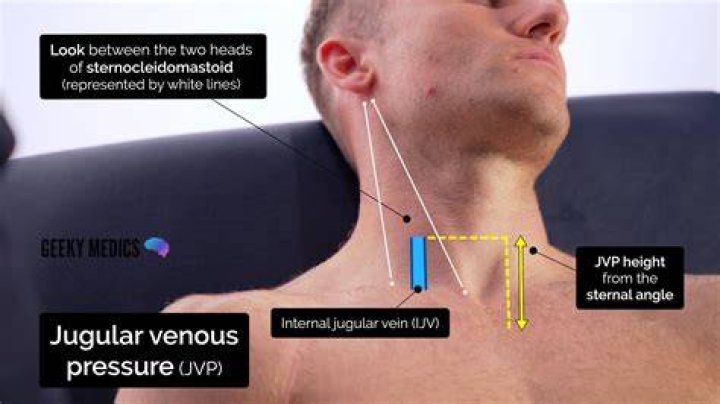
The internal jugular vein is not visible (lies deep to the sternocleidomastoid muscles), is rarely palpable, and the level of its pulsations drops with inspiration or as the patient becomes more upright. The jugular vein pulsations usually have two elevations and two troughs.
Should the jugular vein be visible?
Normal: Neck veins are not visible at 45 o inclination. Neck veins should be visible in supine position. JVP should decrease with inspiration.
Why does my jugular vein pop out?
When the left ventricle’s pumping power weakens, fluid can back up into your lungs. This eventually weakens the right ventricle. When your heart’s right side can’t properly empty, blood can back up into the veins, causing them to bulge.
Why is JVP not visible?
When patients lie at 45° the clavicle is about 2 cm above the angle of Louis, meaning the jugular venous pressure has to be at least 7 cm H2O (5 cm + 2 cm) before it will be observed. Unfortunately, because normal central venous pressure is 0-10 cm H2O, with the patient at 45° it is often impossible to see a JVP.
Why can I see the vein in my neck?
The blood flow from the head to the heart is measured by central venous pressure or CVP. Jugular vein distention or JVD is when the increased pressure of the superior vena cava causes the jugular vein to bulge, making it most visible on the right side of a person’s neck.
What is normal JVP?
The jugular venous pressure is usually assessed by observing the right side of the patient’s neck. The normal mean jugular venous pressure, determined as the vertical distance above the midpoint of the right atrium, is 6 to 8 cm H2O.
How do I know if my JVP is high?
It has been taught that the best method for evaluating the JVP is to position the patient supine in bed, elevate the patient’s head to approximately 30–45 degrees, and measure or estimate the vertical height of the meniscus of the right internal or external jugular vein above the sternal angle (angle of Louis) which is …
What is a normal CVP?
A normal central venous pressure reading is between 8 to 12 mmHg. This value is altered by volume status and/or venous compliance.
How accurate is JVP?
Among patients with a neck circumference ≥40 cm, residents accurately predicted an elevated CVP with US-JVP 58% of the time (p = 0.02) compared to just 46% of the time by PE-JVP (p < 0.01).
Why is JVP raised in heart failure?
Elevated jugular venous pressure is a manifestation of abnormal right heart dynamics, mostly commonly reflecting elevated pulmonary capillary wedge pressure from left heart failure. This usually implies fluid overload, indicating the need for diuresis.
Article first time published on
How do you know if you have a blood clot in your neck?
Blood clots can cause swelling in the veins of your neck or arms, but this is rare. Thrombphlebitis affects superficial veins and is a different condition than a deep vein thrombosis (DVT). Symptoms of thrombophlebitis include swelling, redness, and tenderness over the affected vein.
How do you assess for jugular vein distention?
To properly evaluate jugular venous distension, the patient must be placed at a 45-degree angle, or slightly less. Visualization of the jugular veins is best done at an oblique angle, so sit beside the patient and elevate the head of the cot into a semi-Fowler’s position.
What does a bulging carotid artery mean?
What is an extracranial carotid artery aneurysm? An aneurysm is a bulging or ballooning in the wall of a blood vessel. It is caused when a portion of the artery wall weakens. Like a balloon, as the aneurysm expands, the artery wall grows progressively thinner, increasing the likelihood that the aneurysm will burst.
Is JVP palpable?
Palpability: the pulse of the JVP is not easily palpable, whereas the carotid pulse is typically easy to feel.
What does a low JVP mean?
Simply stated, an elevated JVP of greater than 9 cm H2O (venous hypertension) along with other symptoms can help distinguish between left and right heart failure, suggest pericardial disease, and suggest some specific types of arrhythmias.[4] Conversely, a low JVP of less than 5 cm H2O can reflect either hypovolemia or …
What is considered a low CVP?
Thus, low CVP values (including CVP = 0) may still be associated with adequate cardiac output if the upstream and downstream pressures are appropriate. Similarly, high CVP values do not guarantee adequate cardiac output, and our efforts to increase CVP can “backfire” and result in effects that actually inhibit flow.
What if CVP is negative?
Negative values suggest hypovolemia, while increased values suggest right-sided congestive heart failure, caval obstruction, or iatrogenic volume overload. Interpreting changes in pressure over time rather than interpreting single measurements increases the diagnostic utility of CVP measurement.
What happen if CVP is high?
Based on the rationale provided by the Starling curves and Guyton theory on cardiac function [4], high CVP may impede venous return to the heart and disturb microcirculatory blood flow which may harm organ function, lead to poor prognosis, and even increase mortality.
Can JVP be normal in heart failure?
Almost always present during initial presentation and acute exacerbation of HF, but chronic stable patients may have normal JVP, and may even be low in over-diuresed patients.
What is Mondor's disease?
Mondor’s disease is a condition characterized by thrombophlebitis of the superficial veins of the breast and anterior chest wall. Initially this condition presents with rapid development of a subcutaneous red cord-like lesion that causes pain at an early stage and subsequently becomes a painless fibrous band.
When should I worry about a stiff neck?
A stiff neck is generally not a cause for alarm. However, see a doctor if: The stiffness is accompanied by other symptoms, such as a fever, a headache, or irritability. The stiffness does not go away within a few days and after trying home treatments such as NSAIDs and gentle stretching.
What are the symptoms of brain clot?
A blood clot in the brain may cause weakness in your face, arms, or legs, speech and vision difficulties, headache, and dizziness. Many of these symptoms are the symptoms associated with other conditions, such as heart attacks and stroke.
Is it normal to see Pulse in toddlers neck?
The carotid arteries take oxygen-rich (red) blood back to the brain. Veins and arteries that are easily visible in the neck while a child is resting may be a sign that the heart isn’t pumping blood well.
What causes right sided JVD?
JVD is often caused by life-threatening conditions such as pulmonary embolism, tension pneumothorax, car- diac tamponade, and heart failure,1 and is a classic and crucial finding in the evaluation of all patients presenting with shock.
What does an aneurysm feel like neck?
a stiff neck or neck pain. sensitivity to light. blurred or double vision. sudden confusion.
How do you tell if you have an aneurysm in your neck?
- Sudden, extremely severe headache.
- Nausea and vomiting.
- Stiff neck.
- Blurred or double vision.
- Sensitivity to light.
- Seizure.
- A drooping eyelid.
- Loss of consciousness.
Is an aneurysm visible?
In most cases, an AAA causes no noticeable symptoms. However, if it becomes large, some people may develop a pain or a pulsating feeling in their abdomen (tummy) or persistent back pain. An AAA doesn’t usually pose a serious threat to health, but there’s a risk that a larger aneurysm could burst (rupture).
Why is JVP important?
The jugular venous exam is an important aspect of assessing a patient’s volume status, especially in patients with heart failure, liver failure and kidney failure. Both elevation of the neck veins and the variations of the neck vein waveforms share valuable information about a patient’s diagnosis.