What are the bobbies
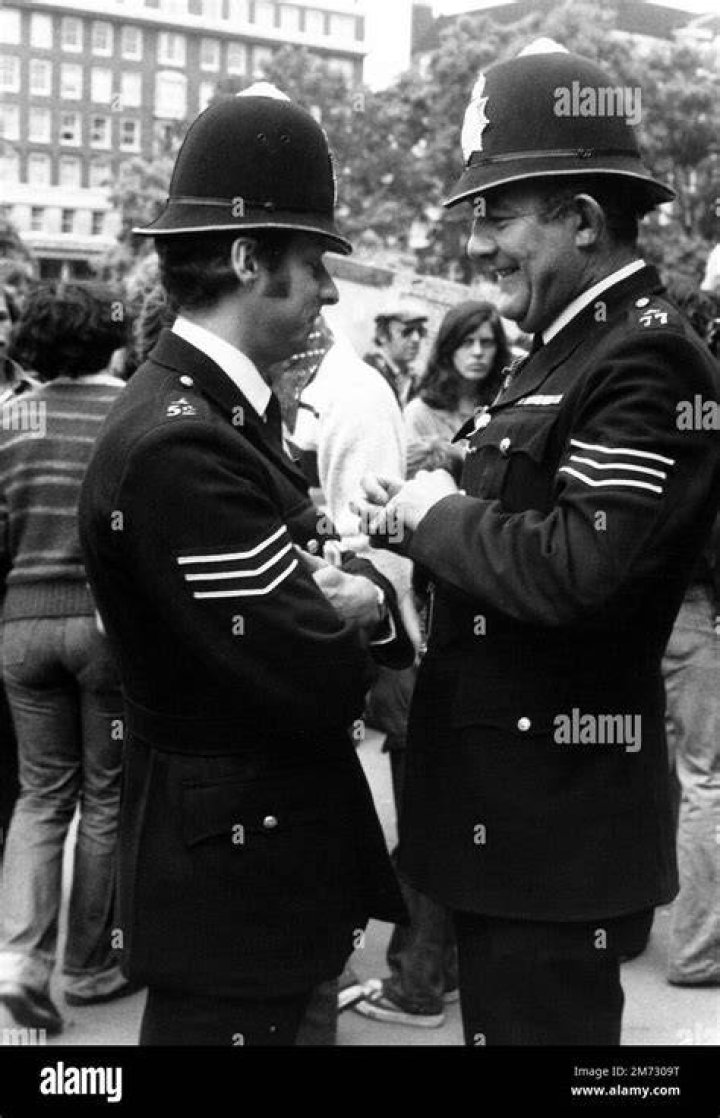
In Britain today all policemen are commonly referred to as ‘Bobbies’! Originally though, they were known as ‘Peelers’ in reference to one Sir Robert Peel (1788 – 1850). … The first thousand of Peel’s police, dressed in blue tail-coats and top hats, began to patrol the streets of London on 29th September 1829.
Why do they call police bobbies?
bobby, slang term for a member of London’s Metropolitan Police derived from the name of Sir Robert Peel, who established the force in 1829. Police officers in London are also known as “peelers” for the same reason.
Why are the London police referred to as bobbies quizlet?
Why are the London police referred to as “bobbies”? They are nicknamed after Sir Robert Peel, who established the first police force in London. … Unlike their federal contemporaries, state bureau of investigations officers are uniformed investigators.
Why are the London police referred to as bobbies group of answer choices?
Robert Peel’s system was a success, and by the mid-19th century large American cities had created similar police forces. In London, the policemen were so identified with the politician who created them that they were referred to as “Peelers” or—more memorably—“Bobbies,” after the popular nickname for Robert.
What does a constable do?
A constable may be an official responsible for service of process: such as summonses and subpoenas for people to appear in court in criminal and/or civil matters. They can also be fully empowered law enforcement officers. Constables may have additional specialized duties unique to the office.
What are the 9 Peelian principles?
To seek and preserve public favor, not by pandering to public opinion, but by constantly demonstrating absolute impartial service to law, in complete independence of policy, and without regard to the justice or injustice of the substance of individual laws, by ready offering of individual service and friendship to all …
What does the word constables mean?
Definition of constable (Entry 1 of 2) 1 : a high officer of a royal court or noble household especially in the Middle Ages. 2 : the warden or governor of a royal castle or a fortified town. 3a : a public officer usually of a town or township responsible for keeping the peace and for minor judicial duties.
What are the three styles of policing?
The police decide which laws to enforce, a process known as discretion. James Q. Wilson identified three styles of policing: watchman style, legalistic style, and service style.
What is a wooden top in England?
Woodentop, a pejorative term used by plain-clothed British police for uniformed police officers.
What are police called in France?
The French police consists of three centralized forces — two of which have the same mission but different jurisdictions at a national scope: National Police (Police Nationale) and National Gendarmerie (Gendarmerie Nationale) and Municipal Police (Police municipale) at a local scope.
Article first time published on
Why are English police officers known as bobbies quizlet?
Nickname of officers in Britain named for Sir Robert Peel. Bobbies replaced the existing( and generally corrupt) system of parish constables and night watchmen. … An act introduced by Sir Robert Peel, which established London’s Metropolitan Police Force.
Which historical era involved close ties between the police and local leaders of government?
1930s-First period, the political era, was characterized by close ties between police and public officials.
What did the Metropolitan Police Act establish?
The Metropolitan Police Act of 1829 introduced a centralized and unified system of police in England. The Act constituted a revolution in traditional methods of law enforcement. … The Metropolitan Police of London became the model for subsequent national police reform.
What is the difference between police and Constable?
Police officers are employed by a governmental organization like a city or state. A Constable is normally a constitutional officer. The incumbent is the senior law enforcement officer in his ward. Depending on the state this position has largely become a ceremonial office.
Why does a Constable came to your door?
1 attorney answer If it is the Constable, he may be trying to serve a summons. if he can’t serve it, the court would issue an arrest warrant.
What is constable in Tuck Everlasting?
The chief law enforcement official in Treegap. He’s a friendly and good-natured man who takes pride in his work.
What is comparative police system?
Comparative criminal justice is a subfield of the study of Criminal justice that compares justice systems worldwide. … It is common to broadly categorize the functions of a criminal justice system into policing, adjudication (i.e.: courts), and corrections, although other categorization schemes exist.
What does policing by consent look like?
“Policing by consent” indicates that the legitimacy of policing in the eyes of the public is based upon a general consensus of support that follows from transparency about their powers, their integrity in exercising those powers and their accountability for doing so.
What democratic policing is and is not?
Democratic policing is a multidimensional, multilevel, and contested concept rooted in political ideology. It is not singular or politically neutral. I argue there are four typologies of democratic policing: right, centre-right, centre-left, and left.
Why are police called woodens?
Woodentop became the first-ever episode to long-running British police television series The Bill. The name woodentop is a colloquialism for beat policemen who traditionally wear helmets; the nickname is itself an allusion to the Children’s TV series The Woodentops.
Where does the term Woodentop come from?
Wiktionary. wooden-topnoun. uniformed police officers. Etymology: The expression may be a reference to the wooden construction of a bobby’s custodian helmet.
What are theories of policing?
Theories of policing, largely comparative in nature, seek to explain why policing systems differ widely in their organization, the powers and authority granted them, the roles and tasks they are entrusted with, the occupational cultures that characterize their work, their interactions with civic society and the state, …
What are the 4 basic styles of policing?
The typology consists of four policing styles: professionals (officers possessing both passion and perspective), enforcers (officers possessing passion but not perspective), reciprocators (officers possessing perspective but lacking passion), and avoiders (officers who had neither passion nor perspective).
What is the concept of policing?
Definition of ‘policing’ 1. the activities carried out by police officers in order to preserve law and order. the policing of public places. 2. the actions of a person or group in authority in order to ensure fairness and legality in an area of public life.
What is Russian police highest rank?
Military ranksSpecial ranksTroop ranksDeck ranksof PoliceMarshal of the Russian Federation—General of the ArmyAdmiral of the FleetGeneral of Police of the Russian FederationColonel GeneralAdmiralColonel General of police
Are gendarmes police?
In France and some Francophone nations, the gendarmerie is a branch of the armed forces responsible for internal security in parts of the territory (primarily in rural areas and small towns in the case of France) with additional duties as military police for the armed forces.
What are police called in Czech Republic?
Czech National Police (Policie České republiky)
How many eras of policing are there?
Different means, methods, or approaches used by law enforcement agencies to tackle issues of crime. There are three commonly acknowledged eras of policing: the political era, the professional/reform era, and the community policing era.
Who made the first ever recorded police organization?
The first policing organization was created in Egypt in about 3000 bce. The empire then was divided into 42 administrative jurisdictions; for each jurisdiction the pharaoh appointed an official who was responsible for justice and security.
Who are the gatekeepers of the criminal justice system?
Police officers are the gatekeepers of the criminal justice process, and they use their power of arrest to initiate the criminal justice process.
How do police build trust?
Building trust with the community is fundamental to effective policing. … Police departments can repair and strengthen community relationships by understanding and training officers on three key concepts: procedural justice, bias reduction, and racial reconciliation.