What is an exception
The term exception is shorthand for the phrase “exceptional event.” Definition: An exception is an event, which occurs during the execution of a program, that disrupts the normal flow of the program’s instructions. … After a method throws an exception, the runtime system attempts to find something to handle it.
What is exception and types of exception in Oracle?
An exception is an error condition during a program execution. PL/SQL supports programmers to catch such conditions using EXCEPTION block in the program and an appropriate action is taken against the error condition. There are two types of exceptions − System-defined exceptions. User-defined exceptions.
What is an exception why it is required?
Exceptions provide the means to separate the details of what to do when something out of the ordinary happens from the main logic of a program. In traditional programming, error detection, reporting, and handling often lead to confusing spaghetti code.
What are exceptions in PL SQL with example?
ExceptionOracle ErrorDescriptionVALUE_ERROR06502It is raised when an arithmetic, conversion, truncation, or size-constraint error occurs.ZERO_DIVIDE01476It is raised when an attempt is made to divide a number by zero.
What is an exception give example?
Difference between error and exception Few examples: NullPointerException – When you try to use a reference that points to null. ArithmeticException – When bad data is provided by user, for example, when you try to divide a number by zero this exception occurs because dividing a number by zero is undefined.
What are the two types of exceptions in DBMS?
There are two types of System defined exceptions – Named System exceptions and Un-named System exceptions. Named System exceptions – These are the predefined exceptions created by the SQL to handle the known types of errors in the code. They are also known as named exceptions.
What is SQL exception?
In PL/SQL, a warning or error condition is called an exception. … When an error occurs, an exception is raised. That is, normal execution stops and control transfers to the exception-handling part of your PL/SQL block or subprogram. Internal exceptions are raised implicitly (automatically) by the run-time system.
Which exception is also known as Oracle exception handler?
ANSWER: Predefined Exception A predefined exception is the one which is executed whenever a program violates any database rule.
How many types of exceptions are there in Oracle?
Exception types There are three types of exceptions: Predefined exceptions are error conditions that are defined by PL/SQL. Non-predefined exceptions include any standard TimesTen errors. User-defined exceptions are exceptions specific to your application.
Why PL SQL Exception handling is needed?
User-defined exceptions are declared in a package, subprogram, or within the declaration section of the PL/SQL block of code and should be assigned names. … Thus the exception handling helps to deal with the errors that are encountered during the run time execution and not while compiling the program.
Article first time published on
What is cursor in DBMS?
A cursor is a temporary work area created in the system memory when a SQL statement is executed. A cursor contains information on a select statement and the rows of data accessed by it. … A cursor can hold more than one row, but can process only one row at a time.
What are the types of exception?
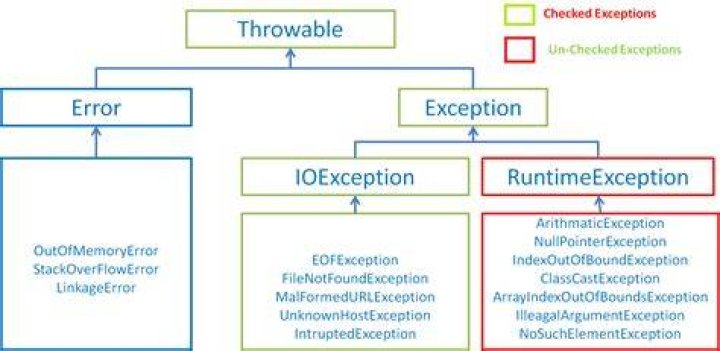
- Built-in Exceptions. Checked Exception. Unchecked Exception.
- User-Defined Exceptions.
What happens when an exception is thrown?
When an exception is thrown using the throw keyword, the flow of execution of the program is stopped and the control is transferred to the nearest enclosing try-catch block that matches the type of exception thrown. If no such match is found, the default exception handler terminates the program.
What's the difference between exception and exemption?
An exemption is an variation of normal precedence, rules or law, allowed by such. An exception is a violation of normal precedence, rules or law, which is not usual or codified.
What are exceptions C?
Advertisements. An exception is a problem that arises during the execution of a program. A C++ exception is a response to an exceptional circumstance that arises while a program is running, such as an attempt to divide by zero. Exceptions provide a way to transfer control from one part of a program to another.
Is exception a class?
All exception and errors types are sub classes of class Throwable, which is base class of hierarchy. One branch is headed by Exception. This class is used for exceptional conditions that user programs should catch. NullPointerException is an example of such an exception.
How do I catch an exception in SQL?
- ERROR_NUMBER() This returns the error number and its value is the same as for @@ERROR function.
- ERROR_LINE() This returns the line number of T-SQL statement that caused an error.
- ERROR_SEVERITY() …
- ERROR_STATE() …
- ERROR_PROCEDURE() …
- ERROR_MESSAGE()
What are exceptions in DBMS?
An Exception is an error situation, which arises during program execution. When an error occurs exception is raised, normal execution is stopped and control transfers to exceptionhandling part. … The exceptions can be internally defined (system-defined or pre-defined) or User-defined exception.
What is named exception?
Named system exceptions are exceptions that have been given names by PL/SQL. They are named in the STANDARD package in PL/SQL and do not need to be defined by the programmer.
How many types of exception are there in SQL?
SQL Server contains the following two types of exceptions: System Defined. User Defined.
What can a cursor FOR loop use?
The cursor FOR LOOP statement implicitly declares its loop index as a record variable of the row type that a specified cursor returns, and then opens a cursor. With each iteration, the cursor FOR LOOP statement fetches a row from the result set into the record.
What attribute returns NULL?
Q. Which attribute returns NULL? The %FOUND attribute returns null if the cursor is open but the fetch has not been executed.
What is true view?
Explanation: VIEW is a virtual table, through which a selective portion of the data from one or more tables can be seen. A view do not contain data of their own.
Which of the following are predefined exceptions?
Predefined exceptions are errors which occur during the execution of the program. The predefined exceptions are internally defined exceptions that PL/SQL has given names e.g., NO_DATA_FOUND , TOO_MANY_ROWS . User-defined exceptions are custom exception defined by users like you.
Can we use exception in function?
In function, an exception should always either return value or raise the exception further. else Oracle will throw ‘Function returned without a value’ error at run-time. Transaction control statements can be given at exception handling block.
How do you make a cursor?
- Declare a cursor that defines a result set.
- Open the cursor to establish the result set.
- Fetch the data into local variables as needed from the cursor, one row at a time.
- Close the cursor when done.
How do you write a loop in PL SQL?
- DECLARE.
- VAR1 NUMBER;
- BEGIN.
- VAR1:=10;
- FOR VAR2 IN 1..10.
- LOOP.
- DBMS_OUTPUT.PUT_LINE (VAR1*VAR2);
- END LOOP;
What is SQL Indexing?
A SQL index is used to retrieve data from a database very fast. Indexing a table or view is, without a doubt, one of the best ways to improve the performance of queries and applications. A SQL index is a quick lookup table for finding records users need to search frequently.
What is ref cursor in Oracle?
A REF CURSOR is a PL/SQL data type whose value is the memory address of a query work area on the database. In essence, a REF CURSOR is a pointer or a handle to a result set on the database. REF CURSOR s are represented through the OracleRefCursor ODP.NET class.
What is normalization in SQL?
“Database normalization is the process of restructuring a relational database in accordance with a series of so-called normal forms in order to reduce data redundancy and improve data integrity. It was first proposed by Edgar F. Codd as an integral part of his relational model.
What is the difference between error and exception?
An Error “indicates serious problems that a reasonable application should not try to catch.” An Exception “indicates conditions that a reasonable application might want to catch.”