What is meant by GFP
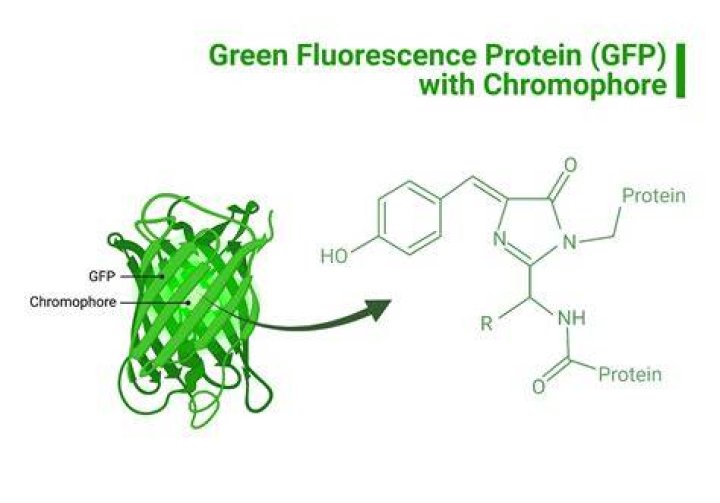
Green fluorescent protein (GFP) is a protein in the jellyfish Aequorea Victoria that exhibits green fluorescence when exposed to light. The protein has 238 amino acids, three of them (Numbers 65 to 67) form a structure that emits visible green fluorescent light. … Biologists use GFP as a marker protein.
What is GFP for biochemistry?
In biochemistry and cell biology, the most highly studied and developed protein is green fluorescent protein (GFP), which is derived from jellyfish Aequorea victoria. … This fluorescent marker enables multicolor labeling and is used in the study of interactions between proteins.
What is GFP and where does it occur naturally?
discovery and development of the green fluorescent protein (GFP), a naturally occurring substance in the jellyfish Aequorea victoria that is used as a tool to make visible the actions of certain cells. Their work with GFP opened a vast set of opportunities for studying biological processes at the molecular level.
Where is GFP found in the cell?
Green Fluorescent Protein – The GFP Site. Green Fluorescent Protein (GFP) has existed for more than one hundred and sixty million years in one species of jellyfish, Aequorea victoria. The protein is found in the photoorgans of Aequorea, see picture below right.
How does fluorescence work?
fluorescence, emission of electromagnetic radiation, usually visible light, caused by excitation of atoms in a material, which then reemit almost immediately (within about 10−8 seconds). The initial excitation is usually caused by absorption of energy from incident radiation or particles, such as X-rays or electrons.
Why is GFP green?
Solutions of purified GFP look yellow under typical room lights, but when taken outdoors in sunlight, they glow with a bright green color. … The protein absorbs ultraviolet light from the sunlight, and then emits it as lower-energy green light.
What does YFP mean?
Yellow fluorescent protein (YFP) is a genetic mutant of green fluorescent protein (GFP) originally derived from the jellyfish Aequorea victoria.
What are fluorescent proteins used for?
Fluorescent proteins can be used to visualize any type of cancer process, including primary tumour growth, tumour cell motility and invasion, metastatic seeding and colonization, angiogenesis, and the interaction between the tumour and its microenvironment (tumour–host interaction).
What is GFP plasmid?
The pGLO plasmid is an engineered plasmid used in biotechnology as a vector for creating genetically modified organisms. The plasmid contains several reporter genes, most notably the green fluorescent protein (GFP) and the ampicillin resistance gene. GFP was isolated from the jelly fish Aequorea victoria.
Why is GFP fluorescence?
1. GFP is a barrel shape with the fluorescent portion (the chromophore) made up of just three amino acids. When this chromophore absorbs blue light, it emits green fluorescence.
Article first time published on
How do you find GFP?
Flow cytometry and fluorescent microscopy are two conventional tools to detect the GFP signal; flow cytometry is an effective and sensitive technique to quantitatively analyze fluorescent intensity, while fluorescent microscopy can visualize the subcellular location and expression of GFP.
How is GFP expressed in cells?
Green fluorescent protein (GFP) has been used as a reporter molecule for gene expression because it emits green fluorescence after blue-light excitation. … After 48 h, vector particles are harvested from the supernatant and applied to target cells, which are then analysed for gene expression.
How do you visualize GFP in a cell?
We find that GFP fluorescence survives fixation in 4% paraformaldehyde/0.1% glutaraldehyde and can be visualized directly by fluorescence microscopy in unstained, 1 microm sections of LR White-embedded material.
Why do jellyfish glow green?
The protein is naturally expressed in the North American jellyfish Aequorea victoria, and works by absorbing energy from blue light in the environment and emitting a green glow in response. … Jellyfish aren’t the only bioluminescent (making their own glow) creatures on the planet.
Do all jellyfish have GFP?
Every jellyfish cell has the GFP gene. The first step in getting the GFP gene was purifying the GFP protein.
What is fluorescence in science?
Fluorescence is the ability of certain chemicals to give off visible light after absorbing radiation which is not normally visible, such as ultraviolet light. … Fluorescence is the ability of certain chemicals to give off visible light after absorbing radiation which is not normally visible, such as ultraviolet light.
How do you explain fluorescence to a child?
Fluorescence is the light given off by certain substances when it absorbs light or other electromagnetic radiation. First the substance absorbs the energy, then it emits light. When the light source is removed, the fluorescence stops occurring. It is a form of luminescence.
Why does the fluorescence occur?
Fluorescence occurs when an atom or molecules relaxes through vibrational relaxation to its ground state after being electrically excited. The specific frequencies of excitation and emission are dependent on the molecule or atom.
How is GFP tag a protein?
GFP-tagging is a way of preparing a sample for fluorescence microscopy by using the GFP as a fluorescent protein reporter. This is done by cloning the GFP in frame with the target protein at either the N- or C-terminus of the amino acid chain.
What is GFP structure?
The crystal structure of GFP was solved in 1996. It has a unique soda can shape. Eleven beta-strands make up the beta-barrel and an alpha-helix runs through the center. The chromophore is located in the middle of the beta-barrel, it is occasionally referred to as the “light in the can.”
How is GFP excited?
GFP can be excited by the 488 nm laser line and is optimally detected at 510 nm.
What is the function of bla gene?
bla — gene that encodes β-lactamase, an enzyme that breaks down the antibiotic ampicillin; transformants expressing the bla gene can be selected by placing ampicillin in the growth medium.
What is transformation in biology?
transformation, in biology, one of several processes by which genetic material in the form of “naked” deoxyribonucleic acid (DNA) is transferred between microbial cells. Its discovery and elucidation constitutes one of the significant cornerstones of molecular genetics.
What does plasmid mean?
A plasmid is a small, circular, double-stranded DNA molecule that is distinct from a cell’s chromosomal DNA. Plasmids naturally exist in bacterial cells, and they also occur in some eukaryotes. Often, the genes carried in plasmids provide bacteria with genetic advantages, such as antibiotic resistance.
What causes a protein to fluoresce?
The intrinsic fluorescence of proteins is caused by three amino acid residues with aromatic side chains: phenylalanine, tyrosine and tryptophan. Out of these three, the latter plays the most important role due to its excitation and emission spectra having the longest wavelength (near the UV range) and longest lifetime.
Do humans have fluorescent proteins?
To date, GFP has been expressed in many species, including bacteria, yeasts, fungi, fish and mammals, including in human cells. … Tsien, Osamu Shimomura, and Martin Chalfie were awarded the 2008 Nobel Prize in Chemistry on 10 October 2008 for their discovery and development of the green fluorescent protein.
What is GFP in flow cytometry?
The use of green fluorescent proteins (GFP) as a reporter in flow cytometry and cell sorting is in its infancy. A major benefit provided by GFP is that it can be measured noninvasively. … In animal cell systems, GFP is particularly suited as an indicator of viral infection.
What is GFP fusion protein?
INTRODUCTIONGFP (green fluorescent protein) fusion proteins have been used to address a wide range of questions in individual cells, as well as in tissues of a particular organism. GFP fusion proteins can be transiently or stably expressed.
What wavelength is DAPI?
When bound to double-stranded DNA, DAPI has an absorption maximum at a wavelength of 358 nm (ultraviolet) and its emission maximum is at 461 nm (blue). Therefore, for fluorescence microscopy, DAPI is excited with ultraviolet light and is detected through a blue/cyan filter.
Why is GFP used as a control?
Due to its size and ease of use, GFP and other fluorescent proteins have become a mainstay in molecular biology. … Transcription Reporter: Placing GFP under the control of a promoter of interest can be used to effectively monitor gene expression from that promoter in a given cell type.
How is PGLO plasmid made?
This recombinant plasmid, created by researchers at Bio-Rad, combines a gene for green fluorescent protein (GFP), cloned from a jellyfish, with control elements copied from a bacterial operon. The end result is a system that allows for bacterial expression of a eukaryotic gene.