Why is desizing done
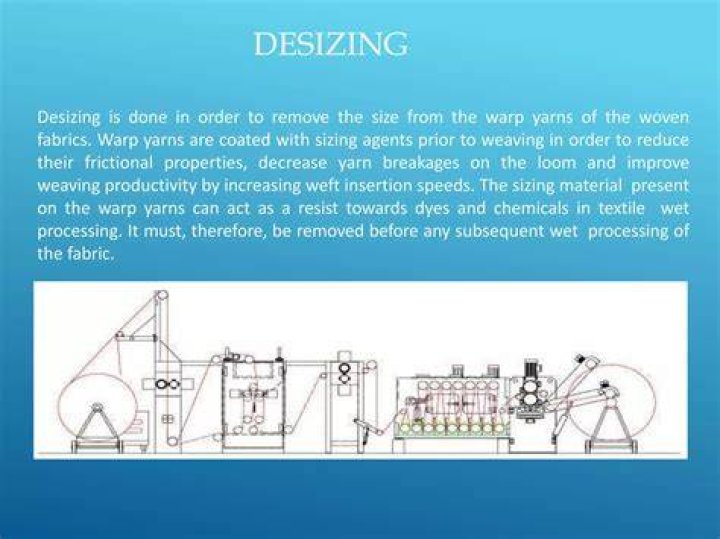
Desizing is done in order to remove the size from the warp yarns of the woven fabrics. Warp yarns are coated with sizing agents prior to weaving in order to reduce their frictional properties, decrease yarn breakages on the loom and improve weaving productivity by increasing weft insertion speeds.
What is desizing in garment industry?
Desizing is the term usually restricted to the process of removal of starch from the fabric. … It is the first wet processing textile technology employed to remove the size material from the fabric. Objective of desizing: The major task of desizing is to remove the size materials from the fabric.
What is desizing in denim wash?
Desizing is the process of removing the size material from the warp yarns after the textile fabric is woven. This is the most important part of denim washing. … During washing, those chemicals must be removed to bring desired look on the fabric.
What is desizing the objectives of desizing?
The purpose of desizing is to remove the size from warp yarn of the woven fabric, a fundamental step before any further treatment of the garment. Among the many varieties of desizing available, utilizing enzymatic desizing is the most adopted method, both for the reduced environmental hazards, and the lower costs.
What is desizing agent?
This desizing agent is a pretreatment chemical used to remove sizing chemicals.
What is textile desizing?
Desizing is the process of removing the size material from warp yarns after a textile fabric is woven.
What is the object of desizing?
The object of desizing is to remove from the grey fabric the size that has been applied during weaving and thus to make the fabric ready for further processes.
What is hydrolytic desizing?
HYDROLYTIC METHODS. Enzymatic desizing is the most widely used method for the removal of starch, amylases being particularly suitable. The advantage in the use of enzymes is that starches are decomposed without damaging cellulose fibre. These are fairly sensitive to temperature changes from the optimum.
Why is desizing necessary for fabric preparation?
In preparation, the mill removes natural impurities or processing chemicals that interfere with dyeing, printing, and finishing. Typical preparation treatments include desizing, scouring, and bleaching. … This, in turn, increases the longevity of fabric finishes applied during finishing.
Which enzyme is used for cotton desizing?
Desizing of cotton substrates with Amylase enzymes has been practiced since long time and is commercially successful. Amylases convert the water insoluble starches, used during sizing operation for enhancing the performance of the warp yarns, into water soluble products which are removed during subsequent washing.
Article first time published on
Why preparatory wet processing is necessary before dyeing?
Preparatory process of dyeing are necessary for removing impurities from fibers and for improving their aesthetic appearance and processability as fabrics. Removal of impurities increases absorbency and whiteness. If a fabric is absorbent it is easier to dye – which is why need increase absorbency.
What is the dyeing process?
A dyeing process is the interaction between a dye and a fibre, as well as the movement of dye into the internal part of the fibre. Generally, a dyeing process involves adsorption (transfer of dyes from the aqueous solution onto the fibre surface) and diffusion (dyes diffused into the fibre).
What are the factors of desizing?
- Desizing a critical process.
- depends, are as follows: •
- Type and amount of size applied. •
- Viscosity of the size in solution. •
- Ease of dissolution of the size film on the yarn. •
- Nature and the amount of the plasticisers in the size film. •
- Fabric construction. •
- Method of desizing. •
Why do we use enzymes in washing plants?
To reduce the adverse effect of stone wash, the garments are washed by using enzymes. The enzyme breaks the surface cellulose fibers of the fabric and removes them during washing. … During enzyme washing, a certain amount of indigo dye and cellulose fibers from the surface of the fabric are removed.
What is dry process in denim?
Denim dry process comes before wet process and it changes the visual appearance by mechanical abrasion without altering the construction and properties. The garment gets a nice look after dry process and also it adds value to the product. Fashionable garments are produced by the dry process.
What are the required time and temperature for the desizing process?
Desizing process Initially weighed grey cotton woven fabric was taken and treated with 2 % HCl and 1 % wetting agent at a temperature of 50–60 °C for 2 h, excluding the time required for heating, which is 15 min at a heating rate 2 °C/min, with a material to liquor ratio (MLR) of 1:30 in a standing bath.
How can we test that desizing is completed?
When a garment is desized, then to check the extent to which starch is removed, a few drops of starch indicator are dropped on the garment. If it changes its color to blue-black, that indicates that desizing process is incomplete and starch is still present there.
What is the ideal pH during desizing process?
The optimum pH of the most reported enzymatic desizing lies between 5 and 7 and the pH range of 6.5-7.5 is generally recommended [2,4,8,[25][26][27][28]. Using this enzyme, enzymatic desizing was successfully carried out in acidic …
What are the disadvantages of rot steeping?
In rot steeping cloth is passed through warm water of forty degrees for this cloth is squeezed up to 100% expression. Although this method is the cheapest but the main disadvantage of this process is it is very much time consuming because it cannot be said that with allocated time sizing material will remove.
What is scouring in dyeing?
“Scouring” is the textile term for cleaning fibers prior to mordanting and dyeing, and does not refer to washing fabrics in a washing machine. If the fiber is not clean, the mordant and dyes will not adhere well to the fiber. Fabrics sold as gray goods or “greige” require a thorough scour.
What is sizing process in textile?
Sizing is an intermediate protective process which is done to prepare the yarn for the weaving process. The process of applying a protective adhesive (synthetic/ natural) coating upon the yarns surface is called sizing.
What is the bleaching process?
Bleaching is the process of decolorization of raw textile material by removing inherent and or acquired coloring components from the fiber. It provides base whiteness to the textile material which could be further whitened with the help of optical brighteners or dyed | printed depending on the desired end use.
Which one is the universal bleaching agent?
To overcome all these difficulties hydrogen peroxide is the solution to the dyeing masters. That’s why it is called universal bleaching agent (H2O2).
What are the aims of bleaching process?
The main objectives of bleaching are to get a sufficiently high and uniform degree of whiteness in the textile materials. To get a high and uniform absorptivity in the textile materials. Bleaching agent occur some damage to the textile materials. So bleaching must be accompanied with minimum fiber damage.
What is the problem that is occurred during desizing due to hard water?
Corrosion can be a serious problem in boiler, if hard water is used in it. Dissolved O2 in the presence of CO2 is the common cause of corrosion. Fe present in hard water reacts with CO2 to form Fe CO3, which is the main process of corrosion.
How many types of hydrolytic desizing are there?
The main application of amylases in textile finishing is desizing, which involves the removal of starch. These enzymes hydrolyze the starch molecules into small fragments that can be easily washed away or dissolved in hot water. There are three types of amylases regarding the temperature and pH condition.
What is CBR in textile?
Job DescriptionA Continuous Range (CBR) Operator is responsible to do the specified job of Scouring- Bleaching & Drying of grey fabric with proper control of parameters to get the desired effect. .
Which process removes cellulosic impurities present in wool?
Carbonizing (removal of burrs): After carbonizing fabric is passed through milling machine when hydrocellulose and hemicelluloses falls down, thus removing all vegetable impurities from wool.
What is the difference between dyeing and printing?
In the dyeing process; only one color is produced but in the printing process; various types of colored design are produced on the fabric surface. … By the printing process, dyes are applied on the fabric localizedly to produce desired design. 2. Fabric, yarn and fibers are dyed by dyeing.
What is preparatory process?
Preparatory processes are necessary for removing impurities from fibers and for improving their aesthetic appearance and processability as fabrics prior to dyeing, printing, and/or mechanical and functional finishing.
What is GREY in textile?
Greige Fabrics Greige fabric is also known as grey fabric and the term grey does not indicate the color of the fabric but the finish. This fabric is unprocessed or unfinished which hasn’t been dyed, bleached and processed. … Another common term for greige fabric is raw fabric.